
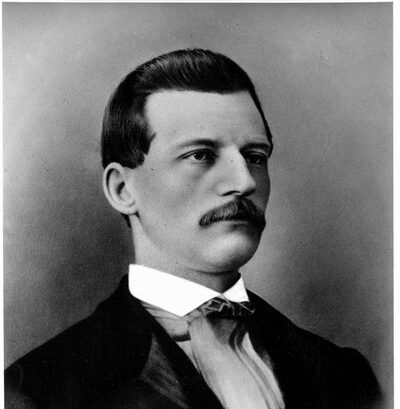
It would be hard to overestimate the lure of gold in our country’s history. Northwest Georgia, where the Bozeman family lived, was a major gold producing area before the California discoveries, which perhaps made the young men of this area particularly vulnerable to the western gold fever. In 1849 when John Bozeman was 14, his father left Georgia and his wife and five children behind to pursue the search for easy riches in California. He was never heard from again.
In 1860, just five days before the state of Georgia seceded from the Union, young John Bozeman left his own wife and three small children for the gold fields of Colorado. His family would never see him again. On April 18, 1867 Bozeman was shot and killed along the Yellowstone River about 20 miles east of present-day Livingston, probably along the emigrant trail he had originally staked out. He was only 32 years old. One of the most contentious mysteries of Montana history today remains, “Who killed John Bozeman?”
It is not clear how his family were supported as Bozeman himself was neither wealthy nor well-educated by today’s standards. In a letter to his mother dated July 1866 he wrote, “Tell Cathrine I would like to pay her and the children a visit but I don’t know when I can as my business is in this country and I cannot leave it very well and I am getting pretty well weaned off the States.” He also mentions, “for fear money is scarce I will send a little greenbacks for you and Cathrine equal.“ In a second letter he writes, “It was mortifying to me to hear that times are so hard there“, and he blamed the Civil War for holding up the mails though he mentioned one letter he had finally received from his wife, and we do not know of any other correspondence between husband and wife.
Bozeman’s journey to our region begins in the winter of 1862-3. After finding the gold fields in Colorado pretty well picked over, he headed with a group for the new gold fields in what would become Montana Territory. Bozeman spent a short time at the early gold diggings on Grasshopper Creek near Bannack, in southwestern Montana. He was reminded again that the hard, dirty and often unrewarding work of gold mining was not to his taste. While seeking more profitable opportunities, he and John Jacobs met and plotted out a new wagon route to Bannack from the Oregon Trail along the Platte River at today’s Glenrock, Wyoming, about 25 miles east of present-day Casper. This would cut off hundreds of miles of slow wagon travel from the safer routes further down the Oregon Trail and through Fort Hall, Idaho Territory. Bozeman would be primarily responsible for gathering emigrants to use the new route to Montana’s gold…for a price.
John Bozeman would become famous for having, with John Jacobs, first staked out the shortcut route off the Overland- Oregon Trail from the Platte River in Wyoming to the gold mining town of Virginia City, Montana. However, Bozeman Trail scholar and author, Susan Badger Doyle writes, “Notably, those who most influenced the routes and character of the trail were the people and forces in place long before John Bozeman attempted his first passage: the Indians, mountain men, and traders in the Rocky Mountains and northern plains. Bozeman pioneered very little of the trail. For most of the route, he was guided by local traders or followed other trains. Yet in our mythic perspective of the past, he has come to symbolize the trail.”
Joseph Marshall, a member of the Lakota Sioux tribe, and early adviser to the Fort Phil Kearny/Bozeman Trail Association said, with some amusement, “You folks blazed a trail right over a route the Indians and buffalo had used for centuries.”
In his first trailblazing effort during the spring of 1863, Bozeman, Jacobs and Jacobs’ young daughter Emma, left Bannack and met troubles along the way to the Platte River. This involved a life-threatening encounter with the Indians and the loss of most of their possessions. After arriving nearly starved at Deer Creek Station, at present day Glenrock, Bozeman and Jacobs got back to business gathering over 40 wagons. They added another guide, Rafael Gallegos, and ventured back northward to the land of gold. They only got as far as Rock Creek, near present day Buffalo, WY, when they were met by roughly 150 Indians, probably Sioux and Cheyenne, who told them if they turned around they would not be hurt…but if they chose to go ahead they would all be killed. Bozeman wanted to continue but Gallegos, and of course most of the emigrants, were fearful and headed back to Deer Creek Station after a failed attempt, by Bozeman, to obtain a military escort and additional wagons.
Bozeman and a few others did continue on to Montana on horseback, and along the way lost their only pack horse and supplies due to a wreck and poor conditions along the trail’s mountainside. Exhausted and nearly starved again, Bozeman arrived back in Montana’s gold camps to the news that Alder Gulch gold sites had been discovered, prompting the building of the famous gold miners’ town of Virginia City. Thousands of prospectors were pouring in, including those from the original sites near Bannack.
Along with the expansion of emigrants, danger expanded too. The Civil War was raging; the Indians were fighting intruders and soldiers through their lands. The miners at Virginia City and elsewhere were being robbed and some killed by road gangs who made it their work to rob those who had found gold, rather than search for it themselves. There was almost no law in the area. In 1863, a group called the ‘Vigilantes of Alder Gulch’ formed. John Bozeman, Nelson Story and famous Montana pioneer and historian Granville Stuart all signed on with the vigilantes. Others signed on including men who would later become Montana Territory’s first U.S. Senator, first Montana Territorial Governor, first Yellowstone Park Superintendent, and editor of Montana’s first newspaper, the Montana Post. Another Bozeman Town businessman, Thomas Cover, also signed on. Shortly after, the vigilantes would move also into the next big gold find at Last Chance Gulch, near present-day Helena.
In just one month the vigilantes hanged many of the road gang, including Bannack’s sheriff, Henry Plummer, and a couple of his deputies. Others they kicked out of the area. Crime slowed down quite a bit and luckily, most Indians in the Bozeman area were friendly Crows.
Besides bringing people into the area, Bozeman’s attention went to farming, raising produce and hauling supplies to Virginia City for sale; partnerships in flour mills and land claims; and building a town aptly first named “Bozeman Town.” He built one of the first houses in Bozeman, a log cabin on what would become Main Street, and partnered in the “first hotel to operate steadily in the little town”. Another impressive group of men established, with some help in planning from both Bozeman and Jim Bridger, the Missouri River and Rocky Mountain Wagon Road and Telegraph Company. This major project included the establishment of ferry boats on the Yellowstone for which Bozeman and Bridger each served as ferryman at one time or another.
In 1864 Bozeman promoted the trail’s vast natural highway and resources looking to gather participants to divert from the Oregon Trail onto his new route. That year several wagon trains took off from the Oregon Trail at different times and traveled generally along the original route Bozeman and Jacobs had staked out in 1863. The Allen Hurlbut train was said to have left first with Bozeman’s large train not far behind. Hurlbut stopped to allow his people to pan for gold in the Bighorns and Bozeman passed him and would arrive in Virginia City first. Dr. John Smith and his sons had a couple wagons and caught up to the Bozeman train, with which they camped nights. Famous mountainman Jim Bridger, then in his late 60s, came off the Oregon trail a bit further along and brought a wagon train through on his own newly-staked route along the west side of the Big Horns. John Jacobs had left Bozeman and brought a train through behind Bridger’s. They and others would all make changes to Bozeman’s original route plan.
In the end, it appears that Bozeman himself only guided emigrants over the entire route once. In fact, the trail was not originally named for him, but had nine other names in that short time. Probably the first was the “Montana Road,” then the “Jacobs-Bozeman Cutoff,” the “Powder River Road to Montana,” the “Virginia City Road,” and others, finally narrowed down to the “Bozeman Trail.” Susan Badger Doyle’s extensive studies of the changes determined that “Jim Bridger had more to do with the final route of the Bozeman Trail than all the others put together.”
The Bozeman Trail’s significant implications as a military route cannot be left unsaid. After the Sand Creek Massacre of more than 230 mostly Cheyenne men, women and children in Colorado on November 29, 1864, the survivors allied with the Lakota Sioux and raged retaliatory war along the Bozeman Trail. In August of 1865, the Arapaho joined them after General Connor’s attack on a friendly Arapaho village at present-day Ranchester, WY. Connor’s establishment of Fort Connor (later renamed Fort Reno) and the 1866 building of Fort Phil Kearny, Wyoming and C.F. Smith, Montana along the trail intensified Indian conflicts and their need to protect their last best hunting grounds in the Powder River Region. The Bozeman Trail went through the very heart of this region. This huge area the Indians were assured use of, by treaty, was bordered by the Black Hills on the east, the North Platte river on the south, the Bighorn Mountains on the west and the Yellowstone River on the north.
Thus, the historical significance of the Bozeman Trail as an emigrant route was more due to its effects on the early residents and settlers of the region than years in service or numbers of emigrants served. It was used heaviest by emigrants in 1866 and it had been closed before General Connor’s disastrous expedition in 1865. Among the Trail’s civilian travelers during 1863-1866 was Nelson Story leading his famous cattle drive past Fort Phil Kearny on their way from Texas to Montana in the fall of 1866. Story’s was one of the last civilian groups through.
Story went through just months before the Fetterman Fight of December 21, 1866, where Fetterman’s entire command of 79 soldiers and 2 civilians were killed and mutilated by the combined forces of the Sioux, Cheyenne and Arapaho. Many of the mutilations were copied from those performed on the Indian families at the Sand Creek Massacre in 1864. After the Fetterman Fight the Trail was closed to emigrant traffic for a second time.
On February 18, 1867, just about two months before Bozeman was killed, then U.S. President Andrew Johnson appointed the Sanborn Commission to investigate the causes of the trouble with Lakota, Cheyenne and Arapaho, culminating in the Fetterman battle near Fort Phil Kearny. The Commission report came down in June and reported, “The cause of the hostility was the military occupation of the Bozeman Trail across unceded Indian country”. The military forts thus built along the trail, in part to protect the emigrants traveling it, had further driven away the buffalo, which had sustained the Indians’ livelihood for centuries. However, they might have, in fact, succeeded in another little-known goal expressed by General Sherman; “to divert the Indians from the building of the transcontinental railroad.”
Susan Doyle writes, “While only about 3,500 emigrants traversed the trail in 1863-66, its significant consequence was that it cut through the Powder River Basin, the last and best hunting grounds of the Northern Plains Indians, and led to military occupation of the region and ultimately resulted in the Indian wars on the Northern Plains. After emigrant use ceased, the trail served as a military road to the forts until it was officially abandoned in 1868 following the Fort Laramie Treaty. It was used again in 1876 by the forces of General George Crook and shortly after the Battles of the Rosebud and the Little Bighorn, the route was opened and used by settlers.” Many of our roads and highways today overlay the various routes of the Bozeman Trail, and some tracks are still visible.
Less than a month before Bozeman was killed, he had written an appeal to Secretary and Acting Governor of the Territory, Thomas F. Meagher, stating “We have reliable reports here that we are in imminent danger of hostile Indians, and if there is not something done to protect this valley soon, there will be but few men and no families left in the Gallatin Valley. Men, women and children are making preparations to leave every day. If you can make any arrangements to protect them, they will stay; if not the valley will doubtless be evacuated”. (Note that Thomas Meagher himself disappeared from the deck of a steamer docked at Fort Benton on July 1st. He was presumed drowned, but no one knows whether it was an accident, murder, or suicide.)
Days before Bozeman left on his fateful last journey with Tom Cover, who was traveling to Fort C. F. Smith to check on supplying flour and other items, he had a premonition his days were numbered. He told his closest friend, W. S. Mackenzie, that he did not expect to survive and tried to get him to go in his place. He told another friend if he didn’t return, to please send his possessions to his mother. Cover and Bozeman would spend a night at Nelson Story’s cow camp and from there travel the next day to a spot on the Yellowstone River near present-day Livingston, arriving about noon on April 18, 1867.
According to Cover, in a letter to the Montana Post, five Indians came up on them and wanted food. Bozeman first thought they were friendly Crows, then realized they were Blackfeet. Cover suggested Bozeman shoot them with his revolver and Spencer rifle. Cover had a Henry rifle, but Bozeman tried to make the best of it and get them something to eat.
Cover stated he had moved back to saddle his horse, and suddenly one of the Indians shot Bozeman through the chest. Bozeman moved toward him but was shot a second time and, according to Cover, it “brought Bozeman to the ground, a dead man.” Then one shot at Cover and left a minor wound on his arm. Cover shot and killed one of the Indians and got away into the brush and hid about an hour until he saw the Indians move out with their dead companion and all the horses and cross the river. Cover then checked on Bozeman and covered him with a blanket, ate about a pound of meat and headed back home afoot, swimming the river on the way. The trip took him into the next day when he walked into Reshaw’s (John Richards’) and Mackenzie’s camp.
Nelson Story was contacted and several men went out to the site and buried Bozeman there. Three years after Bozeman was hurriedly buried on the site of his death, Nelson Story had him reburied in the Story’s family plot in Bozeman. About twenty years later Story erected a monument which read, “In memory of John M. Bozeman, aged 32 years, killed by the Blackfoot Indians on the Yellowstone, April 18, 1867. He was a native of Georgia and was one of the first settlers in Bozeman, from whom the town takes its name.”
There were a few puzzles about his death at the time. His friend Mackenzie was suspicious and wondered why his gun and watch as well as his scalp weren’t taken by the Indians and why, if Cover was shot from some distance, he had powder burns right by the wound. He also wondered why Cover did not shoot the Indians after Bozeman was killed. MacKenzie, who, other than Cover, was the white man closest to the events of the murder of Bozeman, was always unhappy about the explanations of the incident, and he criticized Cover’s action in the affair. However, Story and Cover made an adamant case that Bozeman was killed by Indians. Story wrote many letters saying so, including one to Big Horn, Wyoming pioneer, Vie Willits Garber. As a young woman, Vie had herself ridden part of the trail, mostly alone, about 200 miles from Fort Reno to C. F. Smith in 1908.
After Bozeman was killed there was an outcry among the public, and a huge effort was mounted to get help and protection for the people and their livestock, which were being stolen. Fort Ellis was then established near Bozeman and largely because of it, the town and area grew and prospered. Nelson never wavered in his story, but years later, in 1914, after he and his wife were both dead, his son Thomas Byron (referred to as T.B. or ‘Bine’) Story recalled his father’s account to Jefferson Jones, editor and publisher of the Bozeman Chronicle. Lester Piersodorf, a former employee of Nelson’s, later related a similar story to Jones.
T. B. Story reportedly said, “When Cover reached the Story cow camp sometime after midnight, April 19, and told of Bozeman’s death a herdsman rode to town to give Nelson the news. Story sent an experienced employee and skillful plainsman, “Spanish Joe,” to examine the site and the attack and the surrounding area, first to estimate the number of Indians involved. Spanish Joe reported back to Nelson that he found that Bozeman’s body had not been disturbed. He had encircled the body in ever larger circles and the only footprints he could find in the vicinity were those of Bozeman and Cover. The tracks of only three horses could be found and these led downstream along the riverbank. There were no bloodstains from the Indian which Cover said he had shot, although considerable blood from Bozeman’s wounds were visible.”
T.B.’s son, Malcolm Story later wrote, “Spanish Joe, Nelson had always said, could read the prairies like you read a newspaper. He would see a moccasin track and with his vast knowledge could tell at once what tribe the wearer belonged to”.
According to T. B. his father was shocked at the report and he did not care to follow his suspicion so Nelson Story, therefore, publicly subscribed to the Indian guilt thesis. Nelson even wrote E. A. Brininstool, co-author with Grace Raymond Hebard of The Bozeman Trail, the story blaming the Indians. T. B. himself wrote his own son, Bryon, then writing a history of the family and stated that Bozeman was killed by Indians. Merrill Burlingame came to Montana State College as an instructor in history in 1929 and in 1934 interviewed T. B. Story, who did not share Nelson’s tale at that time either.
Cover had been a very prominent man in the area and was one of 6 men to discover the Alder Gulch gold deposits. He was enterprising and became rich. He and his family would move, probably in the fall of 1878, to southern California. In a search for the legendary “Pegleg” mine in 1884, Cover simply disappeared. An intensive search was conducted, but he was never seen or heard from again.
Lt. George Templeton was at Fort C. F. Smith during the time of Bozeman’s death and kept a diary (now in Newberry Library, Chicago). He wrote, “Mr. John Richard [sometimes spelled Reshaw] accompanied by three men came in about daylight…They left Gallatin Valley 6 days ago. Mr. Richard comes as agent for Mr. Cover about supplying the posts with flour. Mr. Cover and Mr. Bozeman started down some time ago, but these five Blackfeet boys came to them pretending to be Crows and after shaking hands shot Mr. Bozeman and wounded Mr. Cover. The latter fought them three hours when they left him and he made his way home swimming the Yellowstone with his gun strapped on his back. These Blackfeet live with the Crows and are now 15 miles of here.” On June 28 Templeton writes, “The Blackfoot came in….says those four Blackfeet boys who killed Bozeman are still in the Crow camp.”
Susan Badger Doyle writes, “Templeton’s diary recording John Richard’s contemporary account confirms what was known at the time. The Indians who attacked them have been named as Mountain Chief and his two sons and two nephews. They were exiles from their Piegan band of Blackfeet after killing one of their prominent tribesmen and living at a Crow camp but known for horse raiding in the Yellowstone Valley.”
Authors Note: Over 20 years ago, Susan Doyle and I stopped on our way back from Helena to visit Nelson Story’s great grandson, Peter, who lived on the old Story ranch near Emigrant, Montana. Peter told us that he, and the entire Story family, believed Cover was the guilty one. I leaned that way too, but Susan has always believed the preponderance of evidence is that it was the Indians. However, she said “We may never know the truth.”
In recent years, a theater group in Bozeman has come up with a play entitled aptly, “Who Killed John Bozeman?”, and they have a new culprit. The Bozeman Daily Chronicle writes, “The new information points a finger of suspicion at Nelson Story, the richest man in Bozeman–a successful gold miner, cattleman, banker, business owner, mansion builder and donor of the land for the college that became Montana State University.”
According to their story, Marsha Fulton, who co-founded the Extreme History Project said that historians were interviewing descendants about the history of Fort Parker, when they happened to meet Stan Stephans, a retired farmer and rancher from the Crow reservation. Stephans shared a story passed down in his family that Tom Kent, a onetime cattle wrangler for Nelson Story, later a butcher at Fort Parker, once admitted to his family that he killed Bozeman on behalf of Story. It’s quite amazing, Fulton said, “The play is totally breaking new ground.” It was presented at the Museum of the Rockies in recognition of the 150th anniversary of the town’s founding and to take a new look at the mystery surrounding Bozeman’s death.
She cautioned “there’s no way to reach a definite conclusion, no physical evidence to answer the mystery. All the stories have holes in them. And the historians are still exploring more details of Stephans’ story.” But, she says, “We may never know the true story.”
Bozeman’s fame had become great. In just three years in Montana, besides playing a role in establishing the shortcut route through Wyoming, he had been a major player in establishing and the building of the town of Bozeman. He built one of the first houses in that location, and heavily promoted the area. He had claimed 160 acres of land, farmed it extensively and sold and hauled supplies to the miners in Virginia City. He had an interest in a hotel, and much more. Yet, when he died, after paying legal fees and debts there was little left except his legacy and the mystery of his death.
According to Susan Badger Doyle, “The Bozeman Trail, opening during the Civil War and closing prior to completion of the first transcontinental railroad in 1869, has the enduring distinction of being the last great overland emigrant trail in the American West. For a brief period of time the Bozeman Trail and associated historic sites became center stage for the westward expansion of a new nation, the brave resistance to change by the native inhabitants, and the fascinating history of the individuals significant in our national history.
Author’s notes:
Further information as well as often conflicting details of the many various routes and diversions are available from books and materials I’ve used as source material. They include John Bozeman: Montana Trailblazer by Merrill Burlingame; Journeys to the Land of Gold: Emigrant Diaries from the Bozeman Trail, 1863-1866 and Bound for Montana: Diaries of the Bozeman Trail, both edited by Susan Badger Doyle; The Murder of John Bozeman?, a paper by Malcolm Story; and to a lesser extent, The Bloody Bozeman by Dorothy Johnson; Treasure State Tycoon: Nelson Story and the Making of Montana by John C. Russell; The Bozeman Trail by Grace Raymond Hebard and E. A. Brininstool; Centennial Campaign: The Sioux War of 1876 by John S. Gray; Eyewitness to the Fetterman Fight (Indian Views), edited by John H. Monnett; We Are the Ancestors of those Yet to be Born and Survival at Sand Creek by Bill Tallbull; and the article “Historians find new suspect in John Bozeman murder mystery” from the Bozeman Daily Chronicle; Also see the FPK/BTA website at www.fortphilkearny.com
Thank You Acknowledgments:
I extend my gratitude to JoAnne Puckett, who has added to this story from early research, through every aspect, to final version. I thank Susan Badger Doyle for her permission to use quotes which add greatly to the historical perspective so important to this account. Also I thank Dave McKee and Mike Penfold for their reviews and suggestions. Finally, Nan Carrel in her reviews of most of what I write, never fails to see where an account needs clarity as well as improvement in composition. We also thank the Bozeman Daily Chronicle for approval to use clips from past publications, and the Museum of the Rockies, in Bozeman, for permission to use quotes and information from Merrill Burlingame’s history, John M. Bozeman: Montana Trailblazer.